אִם יִרְצֶה הַשֵּׁם
כ״ד בסיון תשפ״ו
The book
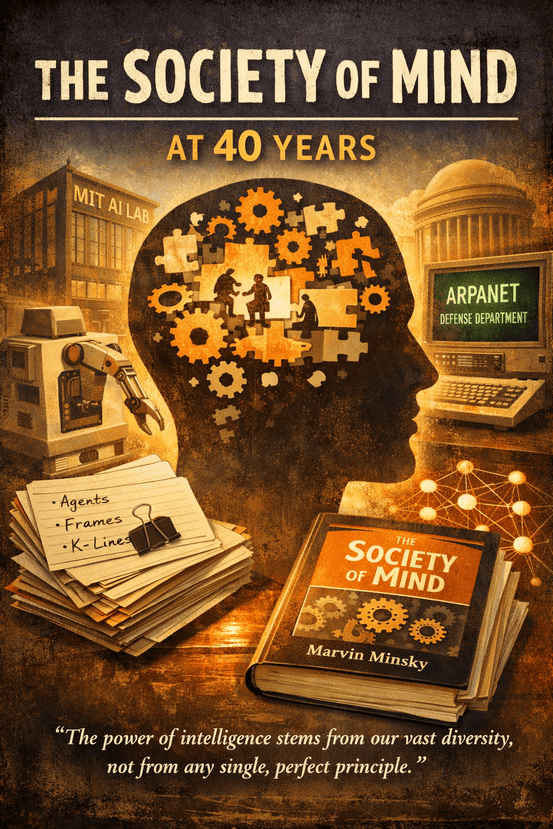
270 essays. 30 chapters. No experiments, no equations, no data. Marvin Minsky published a 1986 trade book that read like a shuffled deck of index cards and claimed to explain the mind. Contemporaries caught the gap fast; the 1991 reviews in Artificial Intelligence read it as philosophy, not science, and by any normal standard it would not survive peer review. Forty years on, the cards are worth re-sorting.
The claim
Minsky's thesis fit on one line. Intelligence has no central engine. The mind is built from many small processes, none of them intelligent on their own, that interact to produce something that looks like thought. He called them agents.
The line everyone quotes: "The power of intelligence stems from our vast diversity, not from any single, perfect principle." It was aimed at a field that wanted a magic bullet. Behaviorism wanted one law. Chomsky wanted one grammar. Newell and Simon wanted one logic. Minsky's answer, threaded through all 270 essays of the book, was that there is no trick, and the absence of a trick is the point.
The book shipped from Simon and Schuster for a general audience. The ideas were grown somewhere else: ARPA/IPTO and ONR money that kept the MIT AI Lab running through the 1960s and 70s. Licklider, ARPA's first IPTO director, framed interactive computing around military command and control.
That funding selected for a set of values before any theory got written. Redundancy. Fault tolerance. Decentralized control. Keep working when nodes die. Those are command-and-control requirements. Whether they are also facts about human cognition is a separate question the book never settles. A mind that degrades gracefully under damage is exactly the mind a Cold War patron needed to be true. Read the architecture with that in mind and some of its confidence looks less like observation and more like inheritance.
An Era of Computational poverty
PDP-10 mainframes. Lisp machines at six figures. The copy-demo robot, an arm and a camera trying to stack children's blocks, that took years to do what a weekend project does now. It could not read an object's shape from vision alone, so it leaned on prior knowledge about which objects were likely to be in front of it.
That constraint is the theory. If you cannot compute perception in real time, you build a society of agents that cover for each other's blind spots. The book is what you write when you can theorize but cannot run. Hand Minsky a GPU cluster and he writes experiments, not aphorisms.
What survived, what did not
| Held up | Fell over |
|---|---|
| Intelligence is modular and heterogeneous | The specific mechanisms: K-lines, frames, difference-engines |
| No single mechanism explains cognition | The bet that symbolic AI would win |
| Negative expertise matters (censors, suppressors) | The 3-to-8-year timeline to human-level AI |
| Conflict between parts, not just cooperation | Learning and statistics as an afterthought |
The shortest way to say it: the modular thesis endured, the mechanisms fell behind. The org chart was right. The wiring was wrong.
Wrong in an interesting direction
Modern multi-agent systems, LLMs prompting and critiquing each other, do vindicate the shape of the claim. Collections of narrow parts produce behavior none of the parts could manage alone. Analyzing the results of generative-agent social simulation: the group behavior was real and none of it lived in any single agent. But these systems get there by gradient descent over distributed vectors, not by hand-wired symbolic agents passing tokens called K-lines. Same silhouette, different body. Minsky predicted the structure and missed the substrate, which is the same gap Harnad's grounding problem kept pointing at: symbols that refer to nothing until something connects them to the world.
The irony compounds with Perceptrons. In 1969 he and Papert bounded what a single-layer perceptron could do. The field read it as a verdict on neural networks in general, the money moved, and the connectionist program went quiet for a generation. He lived long enough to watch the approach he was blamed for stalling come back and take the whole table.
What it is good for now
Not the mechanisms. The discipline. "There is no trick" is an inoculation against single-cause stories, and the AI discourse of 2026 is drowning in them. Scale is all you need. Architecture is all you need. Alignment is all you need. Each is one agent in the field's own society of mind: certain, useful, and partial. The book's gift is the refusal to let any one of them speak for the whole.
The redundancy instinct transfers cleanly to the things I spend time on. Supply chains that survive a dead supplier. Systems with real fallback paths. The npm worms I keep writing up, most recently the trust stack catching fire, fail precisely because one compromised node propagates with no society of independent checks to contain it. A mind built like a shantytown survives losses that a mind built like a cathedral does not. That is a better model for a resilient system than for a human brain, which may be the most useful thing the book accidentally got right.
A book can be wrong in nearly every detail and right in its spirit. Society of Mind got the parts list wrong and the architecture right, which is a better record than most things published with data. Read it slowly. It was written to be read slowly, the one thing 2026 will not let you do.